The Hidden Link Between Music Education and Academic Success
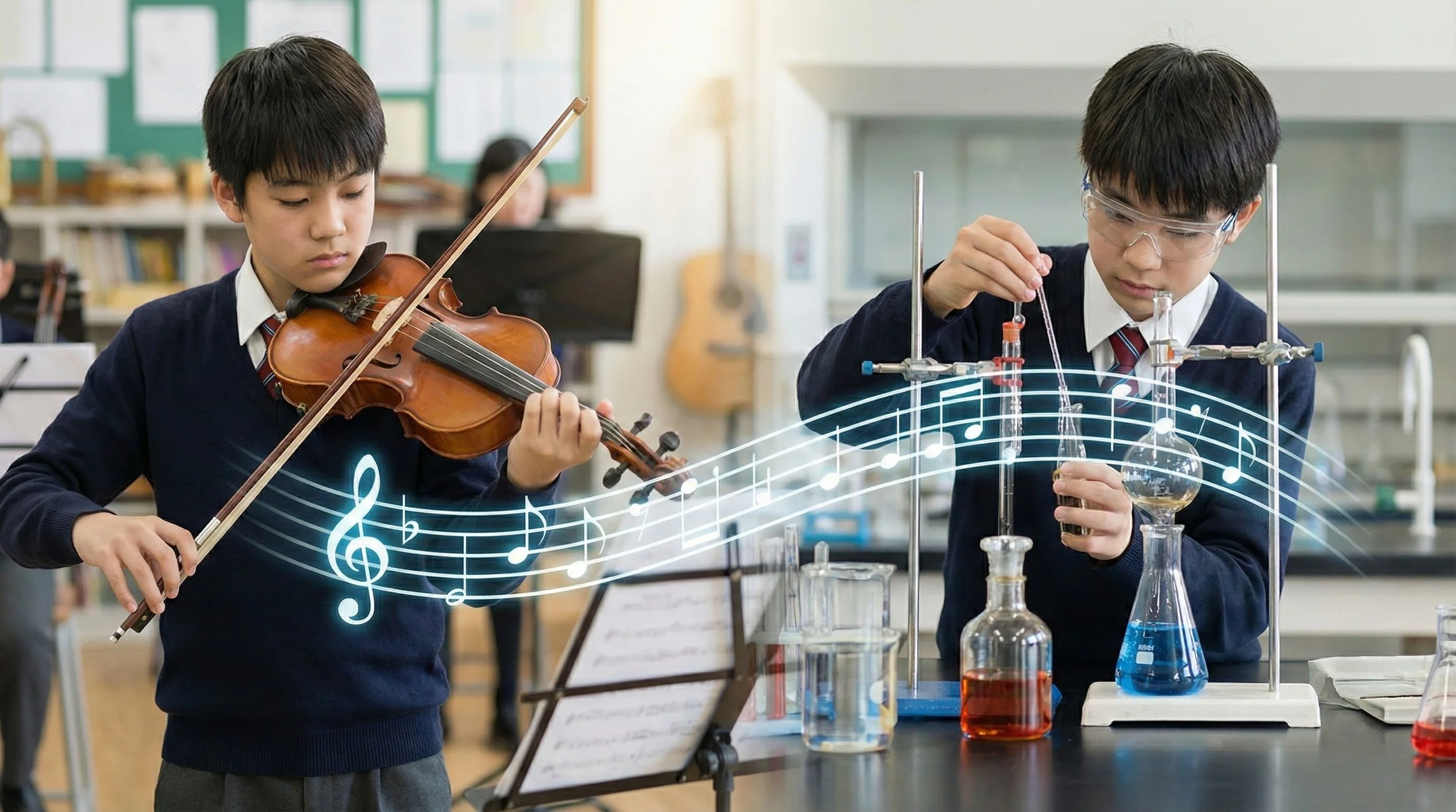
When children take music lessons, they’re doing far more than learning notes and rhythms, they’re building the same mental skills that help them excel in school. From math and reading to science and problem-solving, music education develops the brain in ways that strengthen focus, memory, and creativity. Through structured music instruction, children enhance motor skills, language development, and executive function, forming a foundation for lifelong learning and success.
Research in neuroscience and arts education continues to reveal a strong connection between musical training and academic performance. A long-term study from the University of Southern California’s Brain and Creativity Institute showed that consistent music programs support stronger language processing and academic growth over time.
In short, music learning shapes how children think, and that influence reaches far beyond the music classroom.
Music and Math: Where Numbers Find Their Rhythm
Music and math share a natural connection through rhythm, fractions, and patterns. When students count beats, divide measures, or practice scales, they’re applying mathematical reasoning in motion. For example, learning that a half note equals two beats while a quarter note equals one teaches ratio and division concepts intuitively.
In one study, researchers found that musical rhythm training directly improved children’s math accuracy and numerical processing. The reason is simple: both subjects rely on spatial-temporal reasoning, pattern recognition, and structured thinking.
Even melodic composition mirrors mathematical problem-solving. Students learn to predict, balance, and organize sequences. Every time they keep a steady tempo or recognize a repeating chord structure, they’re strengthening the same logical thinking that supports geometry, algebra, and mathematical skills.
Music and Language: Training the Brain to Listen and Understand
The brain processes language and music in surprisingly similar ways. Both rely on rhythm, timing, and sound recognition. When children learn to distinguish between pitches and rhythms, they’re also improving phonological awareness, the foundation for reading and spelling.
A study published in Nature Scientific Reports found that children who participated in regular music instruction showed faster development in language skills and reading than those in non-musical programs. Researchers concluded that music training sharpens auditory processing, helping students recognize subtle sound patterns that make reading and comprehension easier.
Reading musical notation, too, builds literacy-like skills. Moving from left to right, decoding symbols, and linking them to sound strengthens working memory and visual sequencing, abilities that directly transfer to reading fluency.
In essence, the more children train their ears through musical activity, the stronger their language and cognitive development become.
Music and Science: Listening, Experimenting, and Thinking
Science and music share the same spirit of curiosity. Both rely on observing, testing, and refining ideas. When a student adjusts their hand position to improve tone or experiments with tempo, they’re engaging in real-world problem-solving, the same process used in laboratories and experiments.
Musicians also develop what scientists call executive function, the brain’s ability to plan, focus, and adapt. Studies have shown that students involved in music ensembles demonstrate higher levels of cognitive flexibility and sustained attention, essential skills for success in scientific and analytical subjects.
Even the act of listening attentively, identifying harmonies, noticing pitch changes, or tracking rhythm strengthens neural activity and the brain’s capacity for observation and analysis. These habits of mind are the foundation of scientific thinking and cognitive strengths, confirmed through brain imaging studies showing increased neural pathways development in students with long-term musical training.
Focus, Patience, and Planning: The Academic Advantage
Behind every polished performance lies discipline, structure, and persistence. Music students learn to set goals, manage time, and refine details, habits that support academic excellence.
Breaking down a complex piece into smaller parts, revisiting difficult sections, and celebrating progress all reinforce problem-solving and perseverance. Research in psychology and music pedagogy links music education to improved working memory and self-regulation, skills essential for completing homework, studying for standardized tests, and managing daily challenges.
What makes this growth special is that it feels natural. Students don’t realize they’re building focus and discipline, they’re simply engaging in music-rich experiences that nurture emotional development and spatial intelligence through enjoyable movement activities and musical storytelling.
Building Brighter Minds Through Music
The benefits of music education stretch far beyond the practice room. Children who learn music become better listeners, stronger thinkers, and more confident learners. They gain an understanding of structure from rhythm, vocabulary from lyrics, and curiosity from sound, all of which support success in every subject.
At Play the Art Music Academy, our approach to music instruction blends creativity with cognitive development. Every lesson strengthens focus, coordination, and confidence while nurturing a love for learning. Teachers use adaptive lesson plans rooted in music theory and musical styles, helping students connect the joy of music with skills that support language, emotional, and intellectual growth.
Music lessons aren’t just an extracurricular activity, they’re a proven way to strengthen the brain, inspire curiosity, and spark lifelong success in and beyond the classroom.